
Affiliate marketing looks simple on paper—copy a link, earn a commission—but turning those links into reliable income requires a repeatable system. Whether you want a side hustle that pays your phone bill or a full-time business that replaces your salary, the roadmap below shows exactly how to go from zero to your first (or next) affiliate payout in 2025.
Quick definition: Affiliate marketing is a performance-based model where you promote a merchant’s product or service and receive a commission when someone buys through your unique tracking link.
Why listen to this guide?
- Written for 2025 realities: cookie restrictions, AI content tools, and stricter FTC rules.
- Builds on lessons from the JYA-B post “Unlocking Wealth” without repeating it—here we go deeper into execution, analytics, and scaling.
- Actionable checklists you can finish in a weekend.

Step 1 Choose a Niche That Balances Passion, Profit, and Proof
- Brainstorm 10 topics you already spend time or money on (fitness, anime collectibles, budget travel).
- Validate search demand with Google Trends or a free SEMrush account. Look for keywords with at least 10,000 monthly searches and a steady or rising trend.
- Check product depth: Does the niche have physical goods (Amazon), digital products (Udemy courses), and recurring SaaS offers (ConvertKit)? More products mean more commission opportunities.
- Review competition: If page one of Google is dominated by Forbes and Wirecutter, niche further (e.g., vegan backpacking meals instead of generic camping food).
Pro tip: JYA-B already covers AI side hustles. Pair that angle with a micro-niche like “AI tools for Etsy sellers” to piggyback on an existing traffic stream. See the AI tools roundup at https://jyab.blog/best-ai-tools-for-online-success-paid-free/ for inspiration.
Step 2 Pick Your Primary Traffic Platform
| Platform | Monetization Speed | Skill Focus | Startup Cost |
|---|---|---|---|
| WordPress Blog | Medium | SEO, writing | Domain + hosting (see paid vs free hosts) |
| YouTube | Fast (with viral video) | Video, storytelling | Smartphone + time |
| TikTok or Reels | Very fast | Short-form video | Free |
| Email Newsletter | Slow at first | Copywriting | ESP fee (often free to 1,000 subs) |
If you want evergreen traffic, a blog remains king. Our comparison of the 10 best web hosts explains how to launch for under $40 per year.
Step 3 Join High-Quality Affiliate Programs
There are three main buckets.
| Program Type | Examples | Typical Commission | Cookie Duration |
|---|---|---|---|
| Broad Networks | ShareASale, CJ | 3-30% | 30-45 days |
| Retail Giants | Amazon Associates | 1-10% | 24 hours |
| Direct SaaS | ConvertKit, Elementor | 20-40% recurring | 60-90 days |
Sign up for a mix: Amazon for easy conversions, SaaS for lifetime income, and niche brands for differentiation. Remember to submit tax forms during registration.
Step 4 Create Content That Sells Without Sounding Salesy
- Map the funnel.
- TOFU (top of funnel): “best standing desk benefits” (informational)
- MOFU (middle): “standing desk vs sit-stand converter” (comparative)
- BOFU (bottom): “FlexiSpot E7 review” (transactional)
- Follow the 80-15-5 rule: 80% education or entertainment, 15% soft promotion, 5% hard CTA.
- Integrate links naturally. Example: “For an affordable entry-level mic, I personally use the Fifine K669B. You can check its latest price here.” (anchor on “latest price” not “CLICK HERE!!!!”)
- Add a clear disclosure before the first affiliate link: “This post contains affiliate links. If you purchase, I may earn a commission at no extra cost to you.” The FTC requires it.
- Speed up production with AI: Draft outlines using ChatGPT, then add your personal anecdotes. For a full AI workflow read How to Make Money Online using AI.
Step 5 Drive Targeted Traffic
- SEO fundamentals: keyword in H1, descriptive meta title, 1-2 semantic variations in sub-headings.
- Internal links: Each new post should link to at least two older posts (and vice versa) to spread link equity across JYA-B.
- Pinterest pins for evergreen niches like crafts or recipes can send hundreds of clicks a day after 30-60 days.
- Short-form video: Repurpose blog tips into 30-second reels. Add the affiliate link in your profile link-in-bio tool.
Step 6 Track and Optimize
- Install Google Analytics 4 and set up conversion events for outbound affiliate clicks. Use a link cloaker plugin (Pretty Links) so each affiliate URL has its own slug (e.g., /go/bluehost).
- Weekly review metrics:
- Click-through rate per post
- Earnings per click (EPC) per program
- Revenue per 1,000 sessions (RPM)
- Double down: If one article brings 70% of your clicks, create spin-off posts, comparison tables, or an email mini-course to surround the topic.
- A/B test CTAs: Swap button colors or positions every 1,000 visitors. Free tools like Split Hero make this easy.
Step 7 Scale to a Portfolio
- Diversify platforms: Once the blog is profitable, branch into YouTube. Each video can drive backlinks to your site, boosting SEO.
- Outsource content: Hire writers on Upwork for $0.05-$0.10 per word. Provide a detailed brief so tone matches your brand.
- Build an email sequence: Offer a lead magnet (checklist, template). Deliver 5-7 nurture emails that mix value and product mentions.
- Paid ads: Use profits to test Google Search Ads on proven BOFU keywords. Keep cost per acquisition below 50% of average commission to remain profitable.
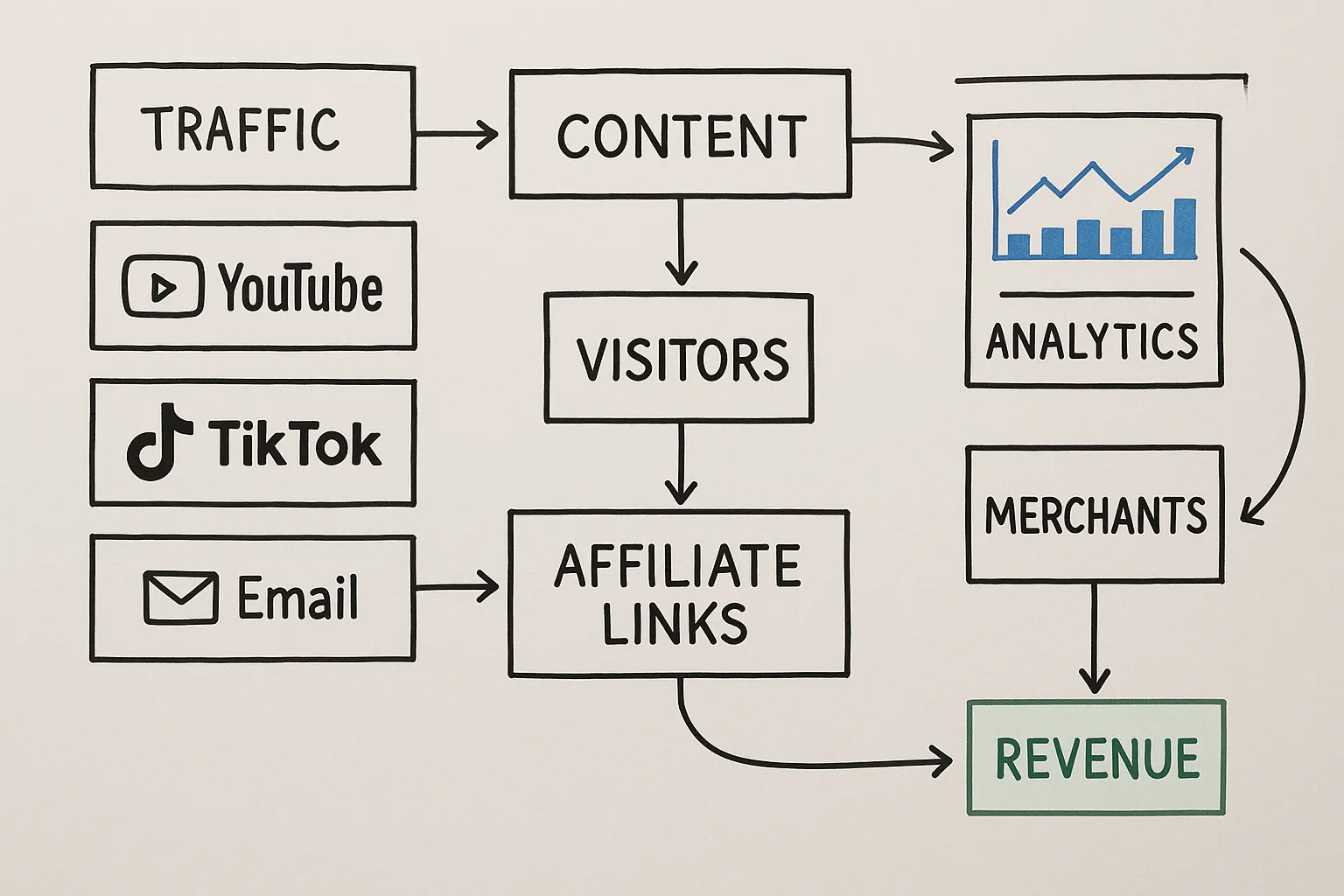
Mini Case Study: From 0 to $1,200/Month in 8 Months
- Niche: Budget home gyms.
- Traffic channel: WordPress blog + Pinterest.
- Content: 30 posts—half informational (e.g., bodyweight workouts), half reviews.
- Revenue sources: Amazon (dumbbells 3%), Rogue Fitness affiliate (5%), ClickBank digital program (50%).
- Key lesson: The digital program accounted for 60% of income thanks to higher commission rate, proving that mixing digital and physical offers pays off.
Frequently Asked Questions
Do I need a website to start affiliate marketing? You can begin on social media or YouTube, but a website gives you full control, SEO potential, and credibility.
How long before I make money? With consistent effort, expect 3-6 months for the first sale and 6-12 months for meaningful income.
Is affiliate marketing saturated in 2025? Competition is higher, but demand for trusted recommendations also grows. Unique angles and high-quality content still win.
What about AI-generated content? Use AI for drafts, then human-edit. Google’s March 2024 update targets low-value AI spam, not well-edited expert content.
How do I stay compliant with the law? Place clear FTC disclosures and respect GDPR or CCPA if you collect visitor data.
Next Steps
Your roadmap is laid out. Pick a niche tonight. Register a domain and hosting tomorrow (our hosting comparison can help). Publish your first review post this week and link back to it from a Pinterest pin or TikTok clip. Then return to this guide each time you level up.
Need more hand-holding? Read “Unlocking Wealth: How to Make Money Online with Affiliate Marketing” at https://jyab.blog/unlocking-wealth-how-to-make-money-online-with-affiliate-marketing/ for beginner basics, then dive into the AI tool stack to boost your workflow.
Happy earning—and remember to track every click so you can celebrate the small wins that snowball into life-changing income!
Leave a Reply